Instructional vs. Educational vs. Learning Technology
A PhD student's relatively unqualified (but apparently sought after!) opinion

Before we begin…
Upcoming Events
Through a whirlwind of emails, I have solidly determined that I will be presenting 7 TIMES over the next two weeks!
On Tuesday and Wednesday, I will be presenting at three panels at the 2025 Association for Educational Communications & Technology (AECT) International Convention, on
1. AI hype and the recurrence of EdTech fads,
2. the difference between emergency online instruction and pedagogically sound online instruction, using COVID-era online instruction as an example, and
3. the impact of focusing on AI tools, and AI in general, on the lack of research in other areas of the ID&T field
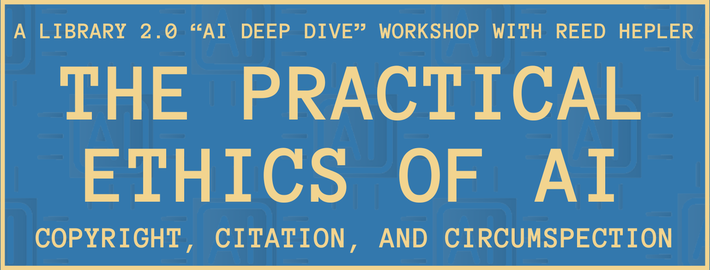
On Friday, I will be presenting on Practical AI Ethics with Steve Hargadon of Library 2.0 and Learning Revolution.
On Monday and Tuesday of next week, thanks to the efforts of Jane Dysart, I will be presenting three times at the Internet Librarian Connect on SearchGPT and other web-enhanced AI search tools, and how they fit in the digital information ecosystem.
Some Context: Supporting Activity with Study and Theory
I know this might be hard to believe, but if you check my transcript and my CV, you can see that I actually had my MLIS and one year in my second Master’s degree before I ever presented on any topic at any conference. I also waited another year before I started doing anything commercial. This is because I wanted to make sure that my presentations that you all are paying for are actually centered on good theory (from others) and frameworks and concepts (from myself) that I have developed over time, iterated, and passed around to other people (including on this blog).
Has every presentation been perfect? No. In fact, one of my colleagues told me that a presentation from three months into my professional career was the worst that he had ever attended. Fortunately, I have improved drastically since then (as evidenced by the fact that people keep attending my presentations and their frequency consistently increases).
Multiple people have stated that one of the reasons that people like my presentations, chapters, and other informational resources is that I apparently have a personable, conversational manner as a presenter. I speak naturally, put my voice into things, and ask about what other people think regarding the subjects about which I am presenting. This is in keeping with Mayer’s Multimedia Principles.
However, I’d like to think that my content is also approachable in its own right. I make my recommendations pragmatic (for example, I don’t insist that users pay hundreds or thousands of dollars for privacy programming).
But What Is Theory, Really?
Ironically, the first presentation I attended at the 2025 AECT International Convention was by the excellent and inspiring researcher Dr. Stephanie Moore at the University of New Mexico. She shared a small qualitative research study that she undertook to analyze how theory was applied to practice by instructional designers in the general field.
The results were honestly surprising. Her four main points were:
Definitions Committee
My attention to theory, and the importance of justifying actions and instruction based on theory, caught the attention of then-AECT President Dousay, who assigned me to the Definitions (and Standards) Committee. We are tasked with creating a working definition of the type of technology that “instructional design and technology” as a field is centered upon.
And that is where my troubles began… ;)
My First Meeting an Accidental Conversation Starter
Midway through the meeting, I mentioned that the focus of the old definition, “educational technology,” was a little narrow by nature of the term being defined. That started a conversation that took up about half of the theory.
My Opinion
My opinion is issue is centered on the idea that our field is not only about education. Education, at least in the common usage, is about information transmission from one generation to another (i.e., to children or youth), usually in a school-like environment. Thus, educational technology would only be technology that is used in the K-12 and college systems. This is very limiting.
A sidenote: I realize that “education” is used in other contexts, such has “adult education,” or “non-traditional education,” which betrays the fact that these adjectives are needed to clarify that they are an adaptation of the standard “definition” of education.
I much prefer “instructional technology.” Instruction is the transmission of information from one person to another, without the constraint, real or implied, of a school-like structure or a generational difference. Instruction happens in professional development, workforce training, and many other contexts.
Others’ Opinion(s)
Other people in the group had two main viewpoints that were different than mine, including yet another term that we might want to define.
The first was that instruction was not the best term, because instruction is merely rote description or presentation of facts or processes. It is, according to these, a subdivision of education, which is the broader process of transmitting knowledge. Education, in this view, can take many forms, and thus is not necessarily constrained by the environment or social aspects of the process.
The other opinion was that “learning technology” would be a better term to define, because learning is more student/learner-centered. Instruction and education are built around the actions and processer of the instructor. Learning is a willful act of the student. In Reigeluth’s “new paradigm,” which are referred to throughout his Green Books, he emphasizes (in the first chapters of each book and in the footnotes) that instructional design theories in the late 20th and early 21st centuries are mostly centered on the agency of the learner.
No Opinion
The fourth opinion is somewhat of a fatalistic opinion; we should have absolutely no opinion on this issue, because it is all semantics. This just seems irresponsible to me, but I see why people were preferring this position. Is it truly important to know exactly what we are researching, if we are at least researching something? As long as we are using our research to earnestly make recommendations and create theories and models, do our definitions matter?
In my opinion, if we are not particular about the words we are defining, then we might as well not have a Definitions Committee. If we do not care exactly what type of technology we are talking about, we might as well just include all the terms in our “defined term” section of the definition.
Rebuttal to the “No Opinion” Opinion
This may be a result of my endeavors in metadata and cataloging and controlled vocabularies, but I am determined to be as specific and particular as possible in my definitions. If I were to define every term I used, my presentations and blog posts would be much more dry (if you can imagine that) and would lose everyone’s attention. Believe me, I used to have definitions throughout all my presentations, and I still define Copyright just so we are all on the same page.
There are the few times that I have lost sight of the importance of theory, but that is mostly when I write. By the time that I create a presentation, it is externally and internally consistent. I think that in several areas, I could create some frameworks or models or learning or instruction. I am specifically focusing on the application of genAI tools to project-based learning. When I write about the Project-Based Learning Model Prompt and the process of creating that, I will show the User Cycle I have created for project-based learning.
And none of that would be possible if I did not have a clear definition in my head, based on previous research by others, of what learning, and project-based learning, should be.
Upcoming Webinar: Practical Ethics of AI
As AI tools become increasingly essential in schools, workplaces, and libraries, from ChatGPT and other mainstream platforms to specialized applications, understanding the ethical implications of their use is no longer optional.
The challenge: Without clear guidelines, learners of all ages and in all environments risk developing AI practices that undermine professional standards, violate copyright, or compromise work quality. Critical questions remain unanswered: How do we navigate copyright when using AI? When and how should AI assistance be acknowledged? How do we maintain the integrity and quality of our work?
The solution: This webinar provides a practical framework for navigating AI ethics through the “Three Cs”:
Copyright – Understanding intellectual property in the age of AI
Citation – When and how to acknowledge AI-generated content
Circumspection – Maintaining quality, accuracy, and professional judgment
Rather than starting from scratch, you’ll discover how to apply time-tested ethics and practices to these new tools, whether in the library, the school course, or in the workplace. Leave with actionable guidelines you can implement immediately in your work and share with those you teach and train.